


EMI Shielding Products
- Custom Gasket Fabrication
- Connector Gaskets
- Bonded O Ring
- Custom Gaskets
- Conduct-O-Knit Knitted Wire Mesh
- Conduct-O-Seal Combo Gasket
- Conduct-O-Elastomer
- Conduct-O-Seal Oriented Wire in Silicone Gasket Material
- Conduct-O-Mesh Tape
- Conduct-O-Foam
- Conduct-O-Bond
- Optical Filters For Electronic Displays
- Shielded Vent Panels
- 300 Series
Should Your EMI Shielding Gasket Be Molded or Spliced?
A large access-panel gasket may use the same cross-section around its entire perimeter. A smaller housing may need changes in height, tightly controlled corners, or features that an extruded cord cannot reproduce easily. Those differences are a better starting point for choosing molded or spliced EMI shielding gaskets than the assumption that a seamless part must always perform better.
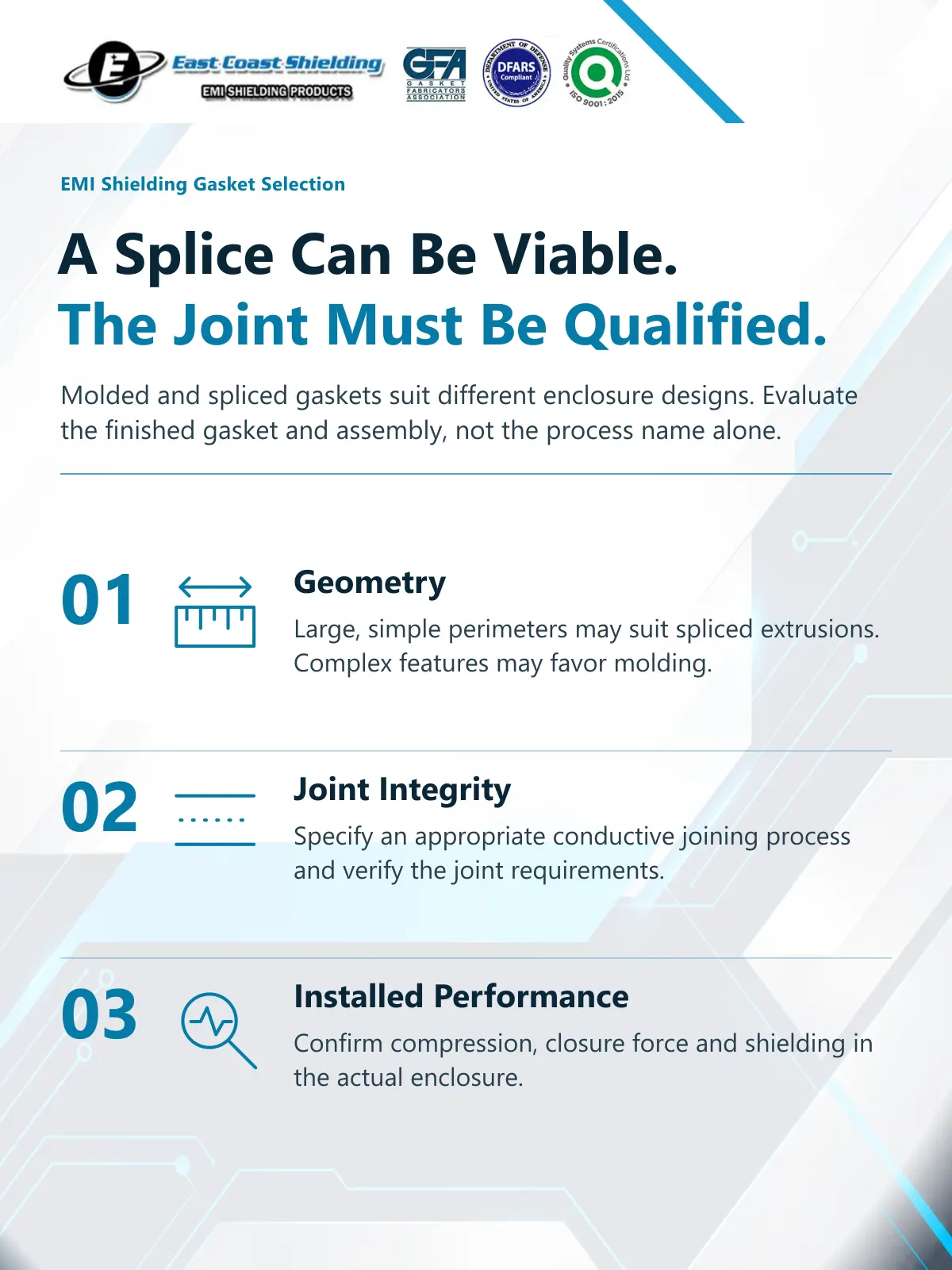
At East Coast Shielding, we recommend comparing the required geometry, material, assembly conditions, and qualification requirements before settling on a manufacturing route. A spliced gasket can be a practical option, but the joint needs to be specified and evaluated. A molded gasket avoids a splice, but that alone does not prove the installed enclosure will meet its shielding or sealing requirements.
Let the shape narrow the manufacturing choice
An extruded and spliced gasket begins as a continuous conductive elastomer cord, hollow O-strip, or channel profile. The extrusion is cut to length and joined into the required perimeter. This can be useful when the cross-section remains consistent and an available profile fits the design. It also allows the team to discuss different perimeter sizes without assuming each one needs a dedicated full-perimeter mold.
A molded gasket is formed in a tool that defines its shape. It is worth considering when the design needs features that are difficult to achieve with a constant extruded profile. However, “small means molded” and “large means spliced” are not reliable selection rules. The available tooling, dimensional requirements, material, and expected quantities still need to be reviewed for the actual part.
Consider a rectangular cover whose groove accepts one continuous profile, compared with a housing whose sealing path changes elevation. The first gives you a reasonable basis for asking about a spliced option. The second calls for a closer discussion of how the part will be formed and controlled dimensionally. Neither example establishes a shielding result; it identifies the manufacturing question that should be resolved first.
Treat the splice as a specified feature
The core concern in high-frequency shielding is electrical continuity. A joint must be considered as part of the conductive path rather than treated as an incidental piece of assembly work. “Bonded” is not enough information on its own. Ask which material and joining process are proposed and what evidence applies to that combination.
East Coast Shielding offers spliced or vulcanized O-rings in conductive and nonconductive materials. That distinction matters: an environmental seal is not automatically a conductive shielding gasket. Identify the required function when requesting a quote, and do not substitute a nonconductive material simply because its size and appearance match. If environmental sealing is also required, specify that separately rather than infer it from a shielding rating.
Do not assume that a splice has the same electrical, mechanical, or sealing performance as the parent material without applicable evidence. Likewise, the presence of a splice is not proof that it will fail. The useful comparison is between documented candidates under the conditions your assembly requires. Request clarification if a data sheet describes material properties but not the finished joint or configuration being supplied.
Design question | Why it matters to the choice |
Is the cross-section constant around the perimeter? | A standard extrusion may fit; changing geometry may favor another fabrication route. |
What joint and corner construction are proposed? | The finished perimeter, not just the straight stock, must meet the requirements. |
How much force can the cover and latches provide? | The gasket must make suitable contact without an unsuitable assembly load. |
What tests and acceptance criteria apply? | A material rating alone does not qualify the finished enclosure. |
Check what happens when the cover closes
A gasket that fits neatly into a groove can still be a poor choice if the cover cannot compress it appropriately. The relevant information is the proposed profile's force and deflection data, the available gap, and the enclosure's construction. Use the supplier's requirements for that specific profile rather than a universal compression percentage. The process label, molded or spliced, does not answer this question.
For example, a team comparing two candidates might find that both fit the same nominal groove, but one needs more closing force than the panel can reasonably accommodate. That changes the selection discussion before tooling cost is considered. It may call for a different profile or changes to the assembly, not a simple decision to eliminate the splice. Evaluate the actual design rather than solve one feature in isolation.
Compare complete proposals, not just piece prices
Ask each proposed route to identify material, dimensions and tolerances, tooling where applicable, quantities, lead time, and the documentation supplied. Include prototype or qualification requirements in that discussion. A low piece price is not a useful comparison if one quote omits a required joint specification or test. Conversely, paying for a custom tool is not justified merely by an unsupported assumption that molded parts always shield better.
Before releasing the part, resolve:
· The exact material and profile, including conductive versus nonconductive construction.
· The finished dimensions, corner details, and location or treatment of joints.
· The installation conditions and applicable compression requirements.
· The qualification evidence required for the part and the separate verification required for the assembled equipment.
Choose the route that fits the assembly and can be verified
Splicing deserves consideration when a suitable continuous profile can form the required perimeter and the joint meets the specification. Molding deserves consideration when the geometry, tolerances, production needs, or qualification requirements favor it. Neither route earns an automatic performance advantage without examining the finished part and its installation.
Send East Coast Shielding your gasket drawing, enclosure details, material requirements, quantities, and required test documentation. Ask us to compare the available fabrication options for that design. The goal is a quote you can evaluate against the assembly requirements, not a general promise that one process is always better.